Pages

Saturday, February 22, 2014

Find a Way

Today we heard a Faith and Reason lecture from Dr. Allan Carlson on perception of marriage and family in American history.  He challenged us to reframe the cultural discussion to our advantage by using effective terminology and telling stories well.


It is quite evident that terms such as marriage and family, freedom and ideal womanhood, have entirely different meaning than they had two hundred years ago. In discussion with others afterwards, I realized that an even more important concept has been redefined: love.  Love is the very core of all community.  It is the core especially of marriage.  Therefore, without a proper understanding of love, we cannot defend these time-tested institutions.

How are we to convey the meaning of love to the questioning world around us?  We must "tell true stories," as one of my professors puts it.  We must, whether in fiction or non-fiction, tell a story that is consonant with the truth about human nature, about society, about the world.  And in these stories, we must depict love--the love of God, love for mankind, married love, and love tainted by sin or misunderstanding or horrible grief.

How can we, while living in a fallen world, depict the positive side of Christian love to an audience determined to paint us as negative, bigoted, naive individuals?  We can paint the beauty of love as it ought to be.

But how?  Many of us have never seen a good model of what Christian married love ought to be.  We have never felt the love of a supportive Christian community that did not fall to bickering the minute the elders' backs were turned.  We have never truly learned what it means to love our neighbor for his humanity instead of hating him for his sin, which is an attendant circumstance of his sojourn here on earth.  We do not know what it means to fully trust another person or to give everything possible without fearing our favor will go unnoticed.  Sometimes we fear even our own sinful nature and recoil from this earthly life itself in hatred.

But still we know what the world needs to hear.  We need not ignore the bleak, sin-tattered details of the world around us.  But the light of love can soften the harshness of reality as it first comes to our eye.

So we have one duty today:

Find a way to say, "I love you!"

Monday, February 3, 2014

A Note on Bloomer and the Proper Education of Children

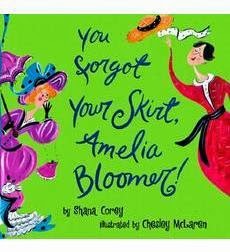
You realize how badly history is warped sometimes?  I am writing a thesis on Amelia Bloomer right now (as most of you know) so I decided to read the main book I could find that had been written about her.  Considering it is one of the few books that has been written on Amelia Bloomer since the late 1800s, I was rather excited to learn what the most accessible modern perceptions of Amelia Bloomer might be.  The book is called You Forgot Your Skirt, Amelia Bloomer! and is written for young children. 

Although the author Shana Corey included a note in the back of the book that told the true story of Amelia Bloomer, the actual content of the book was misleading to the point of being wrong on some very important particulars.  It was clearly intended to further an agenda and to paint history in the light of modern society's improved notions and perspectives.  Corey presented Bloomer as a women's rights activist and extolled Bloomer's impropriety as a groundbreaking feat that literally lightened women's load.  Too many aspects of that statement need clarification or correction for me to be able to state them right here.  (This is why I am spending one hundred pages on the topic . . . .)

But I will also mention the extension activity recommended for teachers using this book to teach history in the classroom.  It was neither scientific nor accurate nor safe.  In an activity geared toward five to seven-year-olds, the teach is to allow each child to carry around a twenty-pound bag (accurately representing the weight of women's clothing in the 1840s) and then compare that to the weight of a child's pant and shirt ensemble.  I say unscientific because should would be comparing the weights of adult clothing and children's clothing rather than choosing one or the other.  It is not accurate because historical children's clothing, even when made in the same styles as an adult's, would not have weighed the same amount.  The activity was also unsafe because most five to seven-year-olds are not strong enough to carry around twenty pounds without hurting themselves.

Friday, January 17, 2014

Recognizing True Love

If love is the essence of true romance, then we should learn to recognize true love.  It is also different from the picture most people have--not because their picture is false, but because it does not go "behind the scenes."

From what I can gather, God decided that this past year was a great time for me to learn about love.  (There were too many lessons to enumerate right now, but several of them have appeared on here in the past six months or so.)  The summer was a time of intensive Bible study and talking with my mother about what God expects of women.  Along the way, we looked deeply into some New Testament passages on Christian virtue, including I Corinthians 13.  There lay the key to recognizing true love.

Years before, one of the elders in our home church had preached every night for a week on building strong marriages.  He spent a great deal of time on I Corinthians 13.  I really remember very little of what he said, but I do remember "The Love Test."  It works to assess either individual virtue or the health of a particular relationship with this test.  He said to insert your name every time charity or love is mentioned in verses 4-8 in order to assess whether you are truly loving.  If married, add your spouse's name as an object of the action.

  • [Blank] is patient and kind.
  • [Blank] does not envy or boast.
  • [Blank] is not arrogant or rude.
  • [Blank] does not insist on his/her own way.
  • [Blank] is not irritable or resentful.
  • [Blank] does not rejoice at wrongdoing, but rejoices with the truth.
  • [Blank] bears all things.
  • [Blank] believes all things.
  • [Blank] hopes all things.
  • [Blank] endures all things.
  • [Blank] never stops [doing all of these things].

There are many things that appear to be love at first glance.  Physical attraction can masquerade as love, but it cannot last alone through the accumulation of wrinkles that come with the difficulties of life.  Emotional connection creates the electricity and fun of flirtation, but it is an inconstant phantom that can redirect at any time (and often does).  Intellectual commonality alone is a dry and dusty business that does not comprehend the true beauty of love.  Spiritual agreement creates brotherly love and fellowship in Christ, but it cannot fully explain romance.

After having studied the love chapter, I remember giving my mom a list of people I know and the virtues I saw in them.  In place of the thorough analysis I expected, she sent me a succinct reply that I will never forget: "But the greatest of these is......"

True love is none of these things by themselves, yet it is compounded of them all.  It is broader and deeper and richer than any other sort of human fellowship.  Perhaps that is just it. . . .  Love is fellowship with another soul.  It can only be had by forgetting oneself--the hopes and dreams and needs and wants wrapped up in the soul--to seek out a true and deep understanding of another soul.  Focusing on another soul.  Considering what might be to that other person's benefit without reference to whether it would satisfy oneself or not.  Giving careful attention to what they say or think in an attempt to truly understand.  Sacrificing time and even personal comfort to serve and help the other individual.  All of these things together are TRUE LOVE.